
Introduction: Mitigating Solar Soiling & O&M Challenges
Modern solar engineering now utilizes self-cleaning perforated grating for solar panel maintenance to solve these issues. By leveraging natural wind and rain, these advanced walkways automate decontamination. This upgrade helps lower LCOE and maximizes long-term ROI.
In commercial and utility-scale solar projects, “solar soiling” is a silent hazard. Dust, pollen, and debris can slash energy yields by 20% to over 50% in high-exposure regions.
Traditional walkways often worsen this by trapping debris and disrupting drainage. This creates an expensive maintenance paradox.
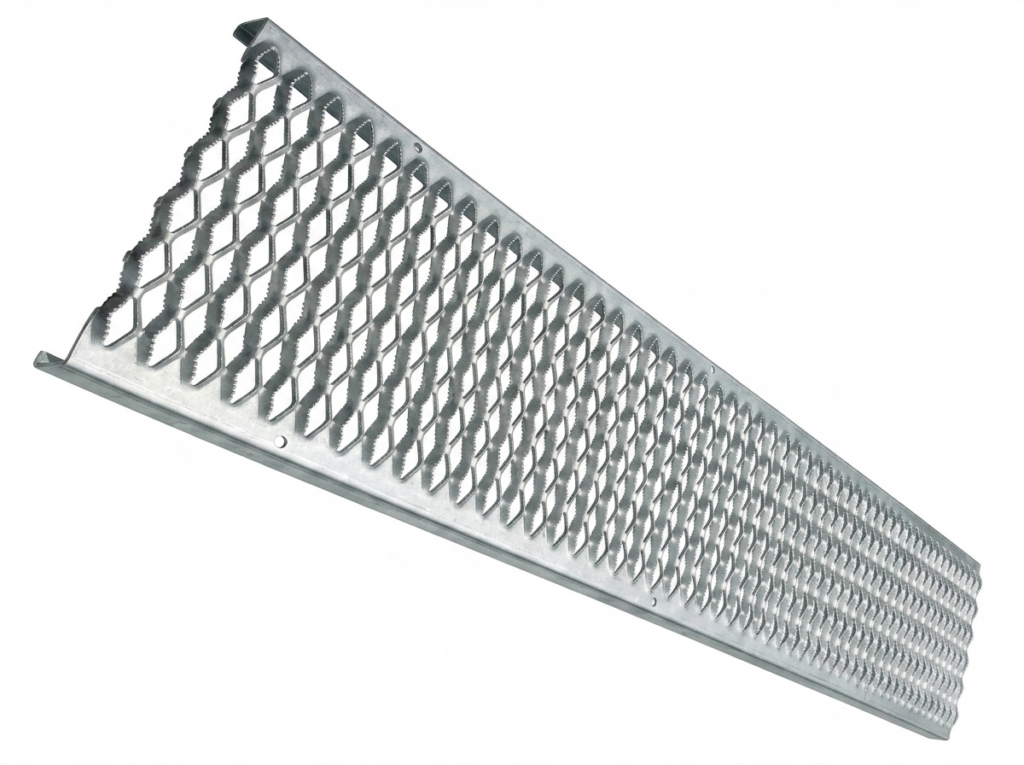
What Is Self-Cleaning Perforated Grating for Solar Maintenance?
Standard maintenance walkways are often dismissed as simple punched metal components.
However, self-cleaning perforated grating for solar panel maintenance is a high-precision structural asset engineered specifically for PV environments.
It balances three non-negotiable industrial demands that standard bar gratings or solid diamond plates simply cannot meet:
- Efficient micro-drainage
- Zero localized debris accumulation
- Continuous anti-slip compliance
Installed along solar rows, it provides a rigid, high-load operating platform for O&M personnel.
Simultaneously, it actively suppresses the accumulation of walkway-derived pollutants that cause panel shading.
The Material Science & Geometry Behind the Self-Cleaning Mechanism
The automatic decontamination capability of this grating relies entirely on passive engineering.
It converts environmental forces like wind and rain into cleaning agents without manual intervention.
Tapered Perforation & Debris-Shedding Geometry
Standard metal gratings feature flat hole lips that easily trap sand, leaves, and organic waste.
Advanced self-cleaning perforated grating for solar panel maintenance utilizes raised embossed or downward-flanged tapered hole structures.
Guided by gravity and natural wind currents, loose debris passes smoothly through the openings rather than settling on the walkway surface.
Photocatalytic & Hydrophilic Surface Treatments
Premium configurations of self-cleaning perforated grating for solar panel maintenance are engineered with proprietary nano-titanium dioxide coatings.
When exposed to ultraviolet (UV) sunlight, the coating chemically decomposes organic contaminants like bird droppings and tree sap.
When rain hits the surface, it forms a continuous sheet of water rather than droplets, lifting dirt away without leaving mineral residue.
Directional Drainage Pathways
The alignment of the perforations is engineered to match the structural pitch of the solar racking.
This layout ensures immediate evacuation of rainwater, morning dew, and snowmelt, eliminating water pooling.
By keeping the walking path dry, it prevents micro-algae growth and protects the lower edges of adjacent PV modules.
Core Benefits of Self-Cleaning Perforated Grating for Solar Projects
Integrating specialized self-cleaning perforated grating for solar panel maintenance is a strategic asset upgrade.
It yields measurable financial and operational dividends for both C&I rooftop and utility-scale installations.
Slashing O&M Costs and Washing Frequencies
Dense, poorly drained walkways act as natural dust reservoirs.
High-velocity winds sweep this accumulated grit directly onto nearby modules, accelerating localized shading.
This forces asset managers into frequent, high-cost manual washing cycles that risk accidental panel scratches.
Field data indicates that installing self-cleaning perforated grating for solar panel maintenance reduces manual washing frequency by 30% to 50% .
This drastically cuts localized water consumption, lowers labor overhead, and mitigates the risk of human-induced module degradation.
Optimizing Albedo for Enhanced Bifacial Solar Panel Yield
Bifacial solar modules capture irradiance from both sides, making rear-side efficiency dependent on ground albedo (surface reflectivity).
Traditional solid walkways cast massive, solid shadows, absorb ambient light, and induce severe rear-side shading.
Modern self-cleaning perforated grating for solar panel maintenance addresses this with an engineered 40% to 60% opening rate.
This structural transparency allows ambient light to pass through seamlessly to the reflective surface below.
Because the grating surface stays clean and dust-free, it avoids light absorption, directly boosting the rear-side yield of bifacial arrays.
Upgrading Technical Safety and Structural Lifespan
Photovoltaic asset maintenance is an inherently high-risk operation, especially on steep roofs or inclined tracking systems.
Moisture-induced slickness and dirt buildup are leading causes of on-site slip-and-fall accidents.
The multi-directional raised embossing and serrated textures of self-cleaning perforated grating for solar panel maintenance provide continuous mechanical traction.
By instantly draining dew, rain, and melting snow, the walkway surface remains stable year-round.
Furthermore, by utilizing marine-grade aluminum alloys or ZAM (Zinc-Aluminum-Magnesium) coated steel, the structures are immune to accelerated rust.
The engineering lifespan of these materials fully matches or exceeds the 25-year warranty cycle of premium PV modules.
Primary Application Scenarios across PV Topologies
Environmental stressors vary drastically by geography, making versatile infrastructure essential.
C&I Industrial Rooftop Walkways
Manufacturing facilities, chemical plants, and logistics hubs are high-pollution environments.
Airborne industrial exhaust, soot, and oily chemical particulates constantly mix with morning atmospheric moisture.
This forms a highly adhesive grime film on roofs and standard walkway mats.
When technicians walk along the arrays, they inevitably track this concentrated grime directly onto the clean glass of the PV modules.
It channels oily residues away immediately, keeping boots clean and preventing cross-contamination of adjacent solar rows.
Utility-Scale Desert & Arid Terrains
The world’s highest-irradiance solar markets are dominated by extreme desert conditions.
While solar resources are abundant, sandstorms and shifting particulate matter are constant operational threats.
Standard walkways trap sand, creating heavy sand drifts that impose unintended dead-weight loads on structural supports.
The high-opening self-cleaning mesh used for solar panel maintenance serves as a physical wind sieve.
High-velocity desert winds blow sand straight through the walkway from any direction.
This prevents sand accumulation, preserves mounting racks, and eliminates abrasive wear on surrounding components.
Advanced Solar Systems: Trackers & Floating PV (FPV)
Debris accumulation and weed growth around single-axis tracker perimeters can jam torque tubes and trigger drive failures.
Deploying self-cleaning perforated grating for solar panel maintenance shades out the soil underneath to inhibit weed growth while keeping the platform pristine.
For near-surface floating solar installations, algae reproduction and heavy bird nesting on maintenance pontoons are massive headaches.
The highly ventilated, self-draining profile of perforated metal eliminates standing water on walkways, actively discouraging biological growth.
Engineering Selection Criteria: Specifying the Right Grating
To guarantee that your auxiliary infrastructure matches the 25-year operational lifecycle, precision procurement is required.
Material Grade: Aluminum Alloy vs. ZAM Coated Steel
The choice of metallurgy dictates both the upfront structural cost and the long-term corrosion resistance.
- Marine-Grade Aluminum Alloy (e.g., Al 5052-H32 or 6061-T6): Extremely lightweight with exceptional native oxidation resistance. This is the premier choice for coastal installations and weight-sensitive C&I rooftops.
- ZAM (Zinc-Aluminum-Magnesium) Coated Steel: Offers superior structural yield strength and excellent self-healing edge protection at a highly competitive cost point.
When sourcing self-cleaning lattice for solar panel maintenance, choose ZAM for large-scale desert ground mounts where long structural spans are required ZAM Structural Grating.
Opening Rate Optimization and Perforation Patterns
The opening rate directly affects self-cleaning efficiency, safety, and rear-side light transmission.
- 45%–60% High Opening Rate: Specifically recommended for desert ground mounts and high-density bifacial solar arrays to maximize wind permeability.
- 30%–45% Moderate Opening Rate: Suited for high-traffic C&I rooftop projects to prevent small dropped O&M tools from slipping through.
For any layout, tapered round holes or slotted oval perforations should always be specified over square configurations.
Smooth, radiused edges prevent dirt from bridging and nesting in sharp corners, maintaining long-term self-cleaning integrity.
Anti-Slip Standards and Structural Load Certifications
Because O&M teams must navigate these pathways during wet or post-snow environments, strict safety compliance is essential.
Ensure your self-cleaning lattice for solar panel maintenance complies with the international DIN 51130 standard, achieving a minimum R11 or R12 rating.
This guarantees secure mechanical traction in wet, oily, or icy environments.
Additionally, the structural design must carry third-party ASTM industrial load certifications to ensure the walkway can support concentrated loads from multiple technicians without deformation.
Conclusion & Custom Engineering Support
As the global renewable energy landscape matures, asset profitability shifts to optimizing refined auxiliary infrastructure.
Solar soiling and inefficient, hazardous O&M pathways are hidden margin killers that restrict power plant revenue.
Implementing self-cleaning perforated grating for solar panel maintenance transforms traditional, passive walkways into active, yield-boosting assets.
By engineering natural wind and rain into your O&M strategy, you lower long-term expenditures and guarantee strict site safety compliance.
Protect the internal rate of return (IRR) of your solar assets by replacing outdated walkway materials with smart infrastructure.
Our manufacturing facilities specialize in the R&D and bespoke production of high-performance self-cleaning perforated grating for solar panel maintenance systems.
We provide fully customized solutions engineered for desert ground mounts, industrial roofs, floating solar, and advanced tracking configurations.
Protect Your Solar Yield Today
- Request a Custom Sample: Test our specialized R11/R12 anti-slip textures and advanced hydrophilic self-cleaning coatings in your local environment.
- Get a Free Engineering Consultation: Work with our team to calculate the optimal material composition, load matching, and opening rate schemes for your project’s blueprint.
✉️ [Contact Our Infrastructure Engineers] today to receive a comprehensive technical proposal and personalized quotation within 24 hours.
Email: [info@solarmountx.com]
About the Author
Dr. Yang Ge, PE
Senior Solar Infrastructure Specialist & Corrosion Control Consultant
Dr. Yang Ge is a professional engineer with over 15 years of experience in global renewable energy infrastructure. A specialist in corrosion science and advanced material durability, Dr. Ge has led structural engineering designs for utility-scale solar projects across diverse high-salinity and extreme-climate regions. He is a passionate advocate for long-term asset integrity and is currently focused on optimizing international maintenance standards to secure a 30-year operational life for PV infrastructure.