
Introduction: The Hidden Risk of Rooftop Solar
Commercial and Industrial (C&I) solar plants are major financial assets. They must deliver clean energy and high ROI for over 25 years.
Achieving peak performance requires regular maintenance. Teams must clean panels, inspect inverters, and check wiring. This creates a critical challenge: How can technicians walk the roof without damaging assets or risking lives?
Direct walking on metal roofs or fragile PV modules causes severe damage. It leads to panel micro-cracks, roof leaks, and costly OSHA safety violations. A heavy-duty perforated walkway solves these issues. It is no longer optional—it is a modern industry standard.
This comprehensive guide breaks down walkway safety engineering, compares materials, and reveals how a smart “2-in-1” design slashes overall installation costs.
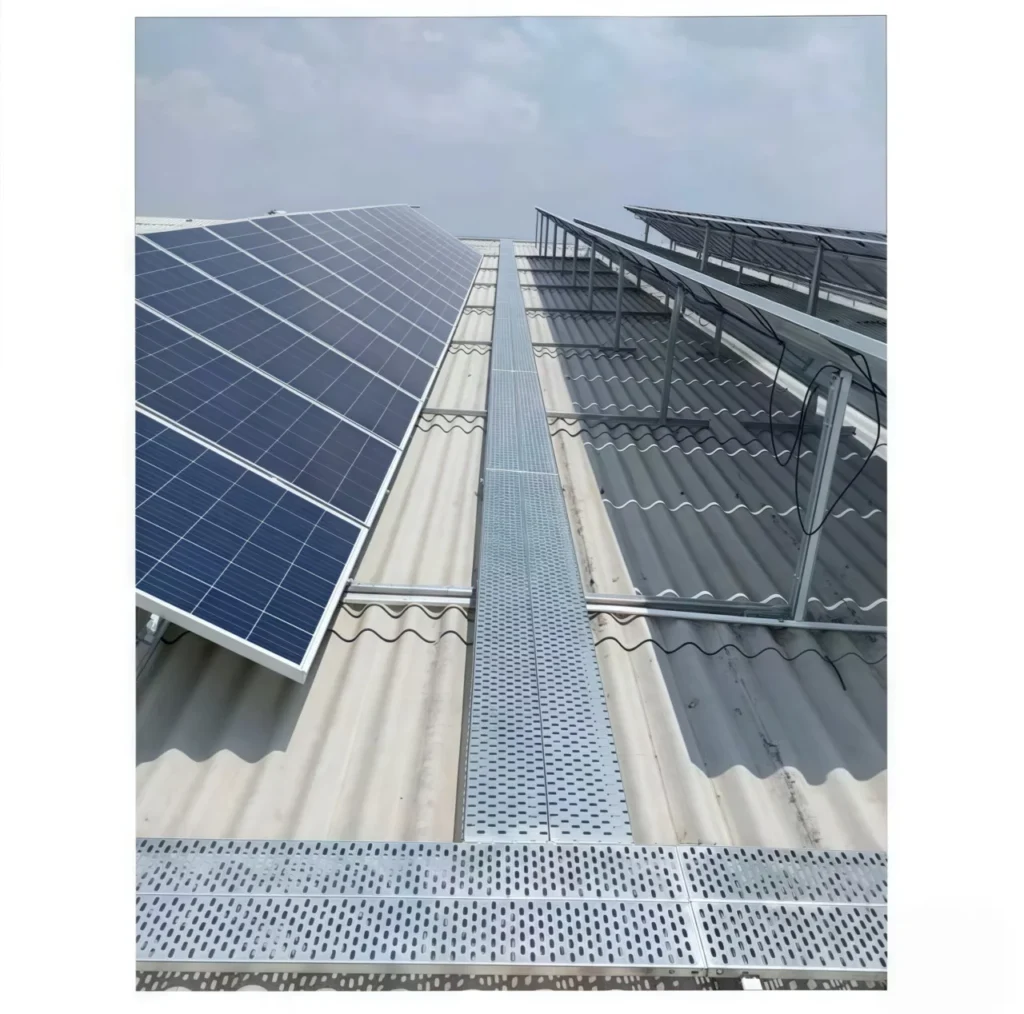
1. Safety Engineering: Why Perforated Paths are Vital
Commercial rooftops are highly exposed environments. Rain, ice, and snow turn metal roof sheets into slip hazards. Falls cause severe worker injuries and massive legal liabilities for asset owners.
An anti-slip perforated walkway mitigates these risks through precise engineering.
Environmental Hazards Controlled
The surface is designed with a 30% to 50% open area. This design delivers three key benefits:
- Zero Wind Uplift: Wind passes through the panels. This reduces uplift forces and protects roof mounting brackets.
- Instant Drainage: Rainwater drains immediately. Water cannot pool on the walking surface.
- Self-Clearing Surface: Snow, ice, and sand fall through the holes. The path stays clear and safe.
Advanced Boot Traction
Top-tier solar walkways feature a raised, serrated pattern. This is known as “Grip Strut” or “Alligator Mouth” perforation.
OSHA Compliance Guaranteed
- Multi-Directional Grip: Sharp, upward-facing edges lock onto boot soles.
- All-Weather Security: The design provides stable traction on $15^\circ$ sloped roofs, morning dew, or heavy mud. It fully meets OSHA safety standards.
- Panel Protection: A designated path keeps workers off the solar arrays. This permanently prevents panel micro-cracks.
2. Material Showdown: FRP vs. GI Walkways
Material choice directly impacts your budget, structural loading, and system lifespan. The B2B market features two main options: Fiberglass Reinforced Plastic (FRP) and Galvanized Iron/Steel (GI).
Material Performance Comparison
| Feature / Metric | FRP (Fiberglass) | GI / HDG (Steel) |
| Material Strength | Moderate (Flexes under heavy loads) | Excellent (High load capacity) |
| Corrosion Resistance | Excellent (Rust-proof) | Very Good (Highly rust-resistant) |
| Fire Safety Rating | Moderate (Requires additives) | Class A Non-Combustible |
| UV & Heat Resistance | Degrades over time under intense sun | Excellent (No UV degradation) |
| Span Capability | Requires close support spacing | Long span capability (Saves brackets) |
| Recyclability | Difficult to recycle | 100% Recyclable (High end-of-life value) |
Structural Integrity & Span Limits
Minimizing roof loading is vital for industrial roofs. GI (Galvanized Iron) walkways offer a much higher modulus of elasticity than FRP.
Reducing Mounting Costs
Steel is highly rigid. Because of this, GI walkways span longer distances without sagging. This means your project requires fewer roof clamps and support brackets. It directly reduces both material and labor costs.
Fire Safety and Roof Heat
Rooftop solar arrays operate at high voltages. Electrical faults are rare but possible.
Eliminating Fire Hazards
- FRP Risks: Plastics require expensive chemical additives to resist fire. In extreme heat, they can release toxic smoke.
- GI Benefits: Steel is inherently non-combustible. Hot-dip galvanized steel easily handles intense summer rooftop temperatures (exceeding 70°C). It will not warp or lose strength.
Long-Term UV Durability
Roofs face intense, continuous sunlight.
Preventing Material Failure
- FRP Breakdown: Constant UV exposure degrades polymer chains. Within 10 to 15 years, the fiberglass becomes brittle and blooms.
- GI Longevity: High-quality GI walkways feature a Hot-Dip Galvanized (HDG) coating ($\ge$ 450 g/m²). This thick zinc barrier blocks UV rays and atmospheric rust. Its service life matches or exceeds the 25-year solar panel warranty.
3. Two-in-One Innovation: Integrated Cable Management
Traditional EPC layouts handle walkways and cable routing separately. This siloed approach creates three problems: double the roof loading, double the installation labor, and a cluttered layout that blocks roof drainage.
An integrated perforated walkway with cable tray functions solves these issues at once.
【 2-in-1 System Cross-Section 】
 ┌───────────────────────────┐  ◄─── TOP: Anti-slip, self-draining walkway
 │   o   o   o   o   o   o   │
 ├───────────────────────────┤
 │  [Cable]  [Cable]  [Cable]│  ◄─── BOTTOM: Shielded, ventilated cable tray
 └───────────────────────────┘
Streamlined System Layout
This system features a protected, hollow chamber beneath the heavy-duty walking surface.
Cutting Project Expenses
- Dual Functionality: The top serves as a safe walkway. The lower chamber functions as a secure cable tray. It protects high-voltage cables from UV rays and physical impacts.
- BOM Reductions: Combining these systems slashes total installation labor by up to 30% and minimizes mounting hardware requirements.
Passive Airflow Engineering
Solar cables carrying high currents generate significant heat. Standard closed conduits trap this heat. This leads to cable degradation and drops in power efficiency.
Lowering Cable Temperatures
The open perforation pattern allows continuous natural ventilation. Passive airflow keeps cables cool. This eliminates thermal hot spots and keeps the plant running at peak efficiency for decades.
4. Engineering Guide: Leak-Free Roof Installation
Roof leaks are a major concern for building owners. Traditional installation requires drilling holes into metal roof sheets. This voids the roof warranty. Professional systems use non-penetrating mounting engineering.
The 4-Step Non-Penetrating Process
- Seam Clamping: Specialized standing seam clamps attach to the roof ribs. They lock tightly via torque. They provide high pull-out resistance without puncturing the roof.
- Bracket Leveling: Custom L-feet fasten to the clamps. Slotted holes allow installers to level the walkway on uneven roof pitches.
- Walkway Positioning: Galvanized steel sections are laid across the brackets. Standard splice plates link the sections into a continuous, rigid path.
- Locking & Grounding: Sections are secured with self-locking bolts. Technicians install star washers or copper jumpers to bond the walkway into the main lightning protection system.
Why Contractors Prefer HDG Steel
- Easy On-Site Modification: FRP splits and creates toxic dust when cut. GI steel cut cleanly on the roof. Installers simply apply cold-galvanizing spray to restore full rust protection.
- Thermal Expansion Match: Steel expands and contracts at the same rate as a metal roof. This prevents stress fractures, warping, and loose fasteners over time.
5. Procurement Guide: Demystifying the Price per Meter
Manufacturers quote the GI perforated walkway price per meter as the standard unit. To avoid budget overruns, check the 4 major cost drivers.
Core Walkway Price Drivers
- Steel Thickness (Gauge): Walkways range from 1.5 mm to 3.0 mm. A 2.0 mm plate offers the best strength-to-weight balance. Thicker steel increases weight and raises the price per meter.
- Zinc Coating Weight:
- Pre-Galvanized (GI): Light zinc coating (approx. 120 g/m²). Low cost, but only for mild inland areas.
- Hot-Dip Galvanized (HDG): Heavy coating (450 g/m² to 600 g/m², ISO 1461 compliant). Higher upfront cost, but prevents rust for decades.
- Width & Profiling: Standard widths run from 300 mm to 500 mm. Standard catalog sizes utilize existing tooling, which keeps prices low. Custom widths add factory setup fees.
- Included Hardware: Always check if the quote includes splice plates, joint connectors, structural bolts, neoprene washers, and roof clamps.
💡 B2B Procurement Tip: Look at Total Cost of Ownership (TCO)
An HDG walkway with an integrated cable tray has a higher material price upfront. However, it cuts installation labor in half and requires zero maintenance for 25 years. This yields a far higher net financial return for the asset owner.
6. Conclusion: Future-Proof Your Solar Investment
Global solar development has shifted. The industry now focuses on maximizing long-term O&M efficiency and safety, rather than just cutting initial setup costs.
A heavy-duty perforated walkway protects your core assets:
- It protects PV modules: No more micro-cracks from workers stepping on panels.
- It protects crews: Fully complies with OSHA regulations, providing safe grip in bad weather.
- It simplifies layout: The 2-in-1 design saves on mounting materials and labor.
- It lasts 25 years: Highly resistant to UV rays and rust, matching the lifespan of the solar plant.
Get a Tailored Layout Today
Every commercial roof is unique. Whether your roof is standing seam, trapezoidal, or flat concrete, you need correct engineering.
Solarmountx manufactures premium, highly durable solar rooftop safety systems. Our facility provides custom profiling, multiple steel gauges, and industry-leading hot-dip galvanization.
Ready to check your project budget?
- Get a Fast Quote: Send us your structural drawings for a competitive GI walkway price per meter.
- Request a Datasheet: Download our installation manuals and load-bearing test reports.
- Free Technical Consultation: [[Contact Us Now]]
- Official Email: info@solarmountx.com
- Visit Our Website: http://solarmountx.com/
7. FAQ: Key Technical Questions Answered
Q1: What is the load capacity of a GI perforated solar walkway?
A: A standard 2.0 mm thick HDG steel walkway holds a concentrated load of 150 kg to 200 kg at mid-span. Its uniform distributed load (UDL) exceeds 250 kg/m². It stays rigid when technicians carry heavy inverters or cleaning gear.
Q2: How do you prevent galvanic corrosion between steel walkways and aluminum roof clamps?
A: Direct contact between steel and aluminum causes galvanic corrosion in wet weather. Professional systems place EPDM or Neoprene isolation gaskets between the steel brackets and aluminum clamps. This completely isolates the metals.
Q3: What is the maximum recommended span between roof support brackets?
A: For a standard 300 mm wide, 2.0 mm thick steel walkway, space supports 1.5 meters to 2.0 meters apart. Larger spans allow the path to flex, which can loosen roof fasteners over time.
Q4: Do perforated walkways require electrical grounding?
A: Yes. Walkways are metallic structures next to high-voltage solar cables. They must connect to the main grounding network. Installers use star washers to pierce the zinc coating or copper jumpers across joints to ensure complete electrical bonding.
Q5: Can walkways be customized for corrosive coastal environments?
A: Yes. Within 5 km of the coast, high salt levels rust standard pre-galvanized steel quickly. We recommend HDG steel with zinc coatings over 85 μm (610 g/m²), or high-grade AL6005-T5 marine aluminum for superior salt-spray resistance.