
UV Resistant Walkway Bridge for Solar Rooftop Protection
Commercial and industrial (C&I) rooftop solar arrays are engineered to generate clean energy for 25 years or more. While asset owners and EPC contractors heavily focus on maximizing power yield, they frequently overlook a critical “asset killer”: the punishing rooftop microclimate. To shield your investment, installing a specialized UV Resistant Walkway Bridge for rooftop photovoltaic systems has shifted from an optional accessory to an absolute operational necessity.
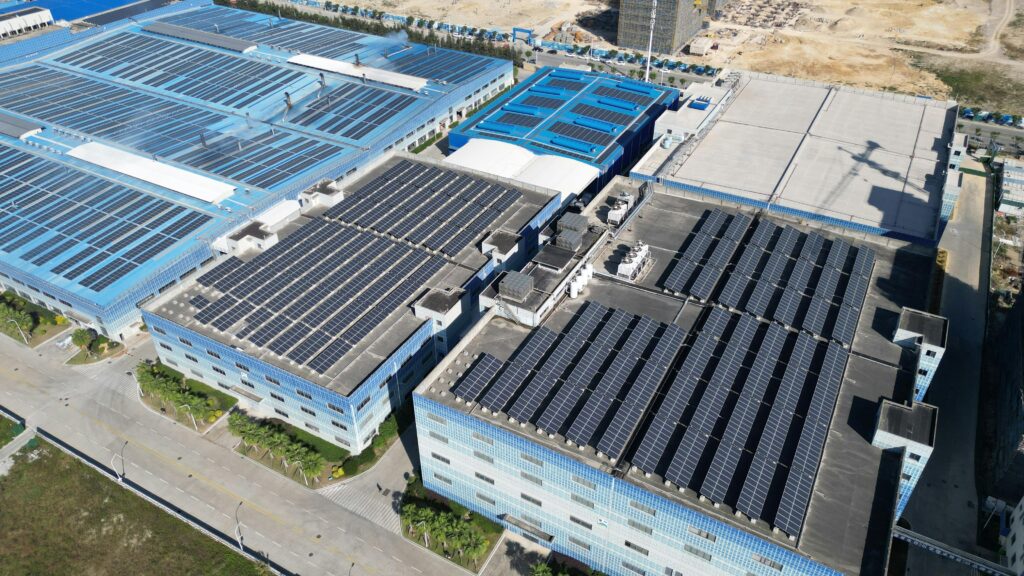
Routine solar operations and maintenance (O&M)—such as panel cleaning, inverter checks, and thermal imaging—require technicians to constantly walk across the roof. Without a dedicated pathway, repetitive foot traffic triggers two devastating issues:
- Rooftop Membrane Leaks: Direct walking punctures fragile TPO/EPDM membranes and strips metal roof anti-corrosion coatings.
- Solar Cell Micro-Cracks: Accidentally stepping on module borders cracks the internal silicon wafers, permanently cutting power output.
Standard plastic pathways or cheap rubber mats quickly crumble under unshielded solar radiation. Implementing an engineered UV-resistant walkway bridge is the only way to safeguard your roof and solar assets simultaneously.
The Hidden Risks of Solar Rooftops: Mechanical Damage & Photodegradation
Repetitive Foot Traffic: Irreversible Mechanical Damage
Solar O&M requires frequent traffic to keep panels clean and maintain inverter efficiency. When crews carry heavy equipment across a raw roof, they cause severe structural strain:
- Waterproofing Punctures: Concentrated weight wears down TPO/EPDM sheets, leading to costly water leaks. Case studies show that leak repairs on unguided roofs can easily cost over $25,000 within three years.
- Cell Micro-Cracks: Technicians crossing rows often step on module edges. This structural flexing shatters the internal crystalline silicon, causing Hot Spots and cutting string efficiency by 5% to 15%.
Intense UV Radiation: Material Failure via Photodegradation
Solar arrays use highly reflective glass, creating a rooftop environment with extreme UV exposure and heat. Unstabilized plastics or recycled rubber materials degrade quickly via photodegradation:
- High-energy UV photons break down the material’s polymer chains.
- The surface quickly exhibits fading, chalking, and bleaching.
- The structure becomes brittle and cracks under standard weight.
Once embrittled, the pathway can snap instantly under a technician’s feet, creating severe fall hazards. Tests show standard plastics lose over 60% of their strength after just 500 hours of QUV accelerated weathering.
The Core Business Value of a UV Resistant Walkway Bridge
Uniform Load Distribution & Roof Warranty Protection
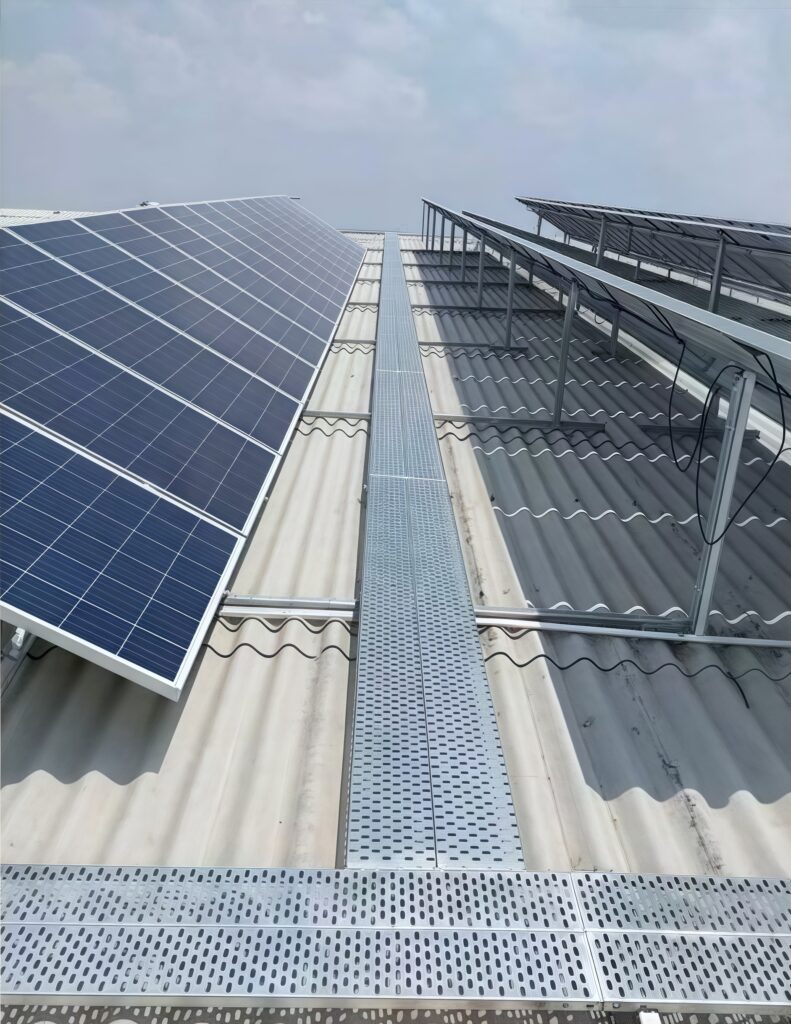
An engineered UV Resistant Walkway Bridge utilizes a rigid, elevated design. It transfers the weight of maintenance crews directly to the building’s structural steel purlins or standing seams. Because the walkway path sits suspended above the delicate roof sheets, (membrane pressure remains at zero), completely eliminating leak vectors.
Standardized Safe Paths for Zero-Micro-Crack O&M
Laying out high-visibility pathways (typically safety yellow or industrial gray) permanently controls traffic flow. Installing a UV Resistant Walkway Bridge forces technicians to stay a safe distance from fragile PV modules and high-voltage combiner boxes. This simple layout reduces human-error cell damage to zero.
Slip Resistance in Wet and Hazardous Environments
Solar panel washing requires vast amounts of water and detergents, creating slick surfaces. Premium UV Resistant Walkway Bridges feature aggressive anti-slip textures, such as open-mesh grids or grit-embedded matrices. These profiles maintain maximum traction when wet, ensuring compliance with OSHA fall protection mandates.
Matched 25-Year Lifecycle for Maximum ROI
A premium walkway contains heavy-duty UV inhibitors blended throughout its structural matrix. When tested under ASTM G154 standards for 3,000 hours, high-grade planks retain over 90% of their flexural strength. This ensures your access paths match the 25-year lifespan of your solar panels, maximizing your project’s overall ROI.
Technical Comparison of the Top Three Solar Walkway Materials
| Material Type | UV Resistance | Electrical Safety Profile | Estimated Lifespan | Best Applications |
| FRP / GRP (Fiberglass) | Excellent (Built-in UV resins & veils) | Completely Non-Conductive (Zero shock risk) | 20 – 25 Years | The Industry Standard: Ideal for high-voltage C&I roofs, high-salinity coastal arrays, and chemical zones. |
| Aluminum Alloy (Structural Grade) | Excellent (Naturally immune to UV) | Conductive (Requires manual grounding) | 25+ Years | Heavy-Duty Spans: Best for bridging wide gaps, extreme wind/typhoon zones, and high-fire-code areas. |
| HDPE / PVC (Engineered Plastic) | Moderate to Poor (Vulnerable to UV aging) | Completely Non-Conductive (Zero shock risk) | 5 – 10 Years | Budget Projects: Only suitable for short-term setups or low-UV geographical regions. |
- Engineering Core: In high-voltage DC solar plants (1000V–1500V), ground-fault current loops are highly dangerous. FRP walkways are favored globally because their non-conductive property eliminates any risk of electrical shock to crews.
Engineering Design & Installation Rules for a UV Resistant Walkway Bridge
A premium UV Resistant Walkway Bridge must protect the building envelope through smart structural engineering.
40%–60% Open Area: Aerodynamic Wind Load Mitigation
Solar rooftops face intense wind velocities. Solid panels act like sails, creating dangerous wind-uplift forces that can rip up the roof structure. An engineered walkway uses an open-mesh grating design (40% to 60% open area) to let wind pass straight through while allowing water to drain instantly.
Slotted Expansion Joints for Thermal Stresses
Rooftops face brutal diurnal temperature swings, shifting by over 40°C (104°F) daily. Because metals and composites expand at different rates, walkway connection points must feature slotted expansion joints. This allows the bridge runs to slide minutely back and forth, preventing the system from buckling or warping.
100% Non-Penetrative Installation: Preserving Roof Warranties
To keep your factory roof warranty intact, construction must follow a strict “zero-drilling” protocol:
- Metal standing seam roofs: The walkway uses specialized aluminum seam clamps that grip the raised rib via mechanical clamping force—no drilling required.
- TPO/EPDM flat roofs: The system relies on ballasted bases or target patches heat-welded directly to the existing roof membrane.
- Both methods provide exceptional stability without creating a single physical hole.
Conclusion: Securing Your 25-Year Clean Energy Returns
As C&I solar arrays expand globally, the market has shifted from minimizing initial installation CapEx to locking in stable, 25-year revenue streams by controlling OpEx.
Every auxiliary component on a solar roof must match the long-term durability of the solar modules. Integrating an engineered UV Resistant Walkway Bridge is a highly calculated, strategic choice. It achieves three vital goals: it shields your roofing asset, eliminates panel micro-cracks, and guarantees worker safety.
Planning a new array or updating an old site? Contact our engineering team today for targeted support:
- New Projects → Free rooftop layout analysis and custom routing design.
- Retrofit Operations → On-site structural evaluation, load verification, and custom quotes.
- EPCs & Distributors → Tiered wholesale pricing, OEM customization, and technical training.
Technical FAQ: UV Resistant Walkway Bridge
Q1: Will installing a solar walkway bridge void my existing commercial roof warranty?
A: No. Engineered systems use 100% non-penetrative installation methods. Metal standing seam roofs use high-strength clamps, while TPO flat roofs rely on heat-welding or ballasted bases. Because the roof is never punctured, the original manufacturer’s roof warranty remains fully intact.
Q2: Why is FRP composite grating preferred over aluminum or steel for solar walkways?
A: FRP is heavily favored because it is completely non-conductive. Solar arrays operate at lethal DC voltages (up to 1500V). If an insulation fault occurs, a metal walkway can become energized, creating an electrocution hazard. FRP provides permanent insulation, requires no manual grounding, and won’t rust in corrosive coastal environments.
Q3: How can I verify that a supplier’s walkway is genuinely UV-stabilized?
A: True UV resistance cannot be checked by eye. You must request independent test reports proving compliance with ASTM G154 or ISO 4892 accelerated weathering standards. Additionally, check for an integrated Surfacing Veil on FRP products, which blocks UV photons from reaching the internal structural fibers.
Q4: Can these UV-resistant walkway bridges handle high-salinity coastal arrays?
A: Yes, but material selection matters. For high-salinity environments, an FRP walkway formulated with premium vinyl ester resin is highly recommended, as it is completely immune to salt spray. If aluminum is required due to local fire codes, it must feature thick marine-grade anodization and 316 stainless steel hardware to prevent galvanic corrosion.
About the Author
Dr. Yang Ge, PE
Senior Solar Infrastructure Specialist & Corrosion Control Consultant
Dr. Yang Ge is a professional engineer with over 15 years of experience in global renewable energy infrastructure. A specialist in corrosion science and advanced material durability, Dr. Ge has led structural engineering designs for utility-scale solar projects across diverse high-salinity and extreme-climate regions. He is a passionate advocate for long-term asset integrity and is currently focused on optimizing international maintenance standards to secure a 30-year operational life for PV infrastructure.
Published: May 2026