
Ground Mount Solar 2026: Ultimate Guide (Cost, Design & ROI)
全球可再生能源转型需要快速、安全且持久的产能部署。在此背景下,地面安装式太阳能系统已从基本的固定倾斜支架发展成为先进的土木和机械工程技术。SolarMountX深知,选择地面安装式太阳能系统是一项战略性投资,旨在提升结构韧性、优化场地发电量并保障资产的长期性能。本指南深入剖析了地面安装式太阳能电池板的各项技术和商业细节,为 B2B 利益相关者提供数据和严谨的工程分析,助力他们在 2026 年及以后构建可融资的光伏项目。
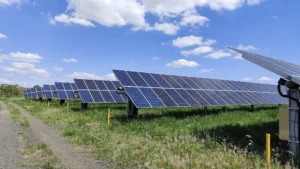
地面安装式太阳能:核心定义和系统架构
地面安装式太阳能装置利用钢或铝制支架将光伏阵列直接固定在地面上,使发电不受建筑物结构限制。这种方法能够实现精确的朝向——北半球正南,南半球正北——并根据纬度和天气情况(而非屋顶坡度)调整最佳倾斜角度。
地面太阳能发电系统的结构分为桩基式和压载式两种。其核心部件包括基础接口(工字钢、槽钢或螺旋桩)、立柱、水平檩条和组件夹具。与依赖微型逆变器遮阴的屋顶系统不同,由于地面太阳能接收均匀,地面安装结构更适合采用组串式或集中式逆变器,从而降低每瓦系统平衡成本。
在B2B领域,标准组件与定制工程结构之间的差距很大。小型商业项目可能使用标准化模块,但公用事业规模的项目则需要进行迭代的线性及非线性屈曲分析。设计目标是在最大化地面覆盖率(GCR,即模块面积除以土地面积)的同时,避免行间遮挡,从而提高内部收益率(IRR)。
公用事业规模项目地面安装式太阳能电池板需求激增
地面光伏发电系统的快速增长得益于各国政府和私人购电方制定的太瓦级部署目标。数据显示,目前陆地上的固定倾角、单轴跟踪和双轴光伏系统占全球年度新增光伏装机容量的60%以上。其主要驱动力在于可扩展性:单个地面安装点即可承载数百兆瓦的装机容量,这是分布式屋顶光伏发电系统无法实现的密度。
Moreover, procurement teams favor ground mount because it standardizes operations and maintenance. Unlike fragmented rooftop portfolios that require truck fleets navigating urban traffic, a utility-scale solar ground mount system centralizes labor. This geographic concentration slashes the Levelized Cost of Energy (LCOE) by cutting variable O&M expenses. In addition, bifacial modules—which capture rear-side light—perform exceptionally well only in elevated ground mount setups, where albedo light reflects from the ground.
Land availability concerns often hinder initial feasibility. However, modern designs repurpose non-arable land, degraded industrial zones, and capped landfills. With dual-use applications rising, ground mount deployments are entering a phase where land productivity increases, not decreases.
Engineering Solar Ground Mount Systems: Load Analysis & Structural Integrity
Engineering a solar ground mount system demands strict adherence to ASCE 7 Minimum Design Loads. The structure must handle dead loads (module and structural weight), live loads (maintenance personnel), and environmental loads such as wind, snow, and seismic forces.
Wind tunnel testing is essential for utility-scale procurement. At SolarMountX, we validate that our designs avoid vortex shedding and aeroelastic flutter. Purlin torsional rigidity must prevent module micro-cracking. For wind load calculations, we use a 3-second gust speed at 10 meters height for the specific Risk Category (RC II or III).
- Wind Exposure Categories: Exposure B (urban/suburban) vs. Exposure C (open flat terrain).
- Corrosion Protection: Hot-dip galvanizing per ASTM A123/A123M, typically reaching ≥85 microns (G90 or heavier) for C4 corrosive environments.
- Deflection Limits: Beams maintain span-to-deflection ratios, usually limiting deflection to L/120 or L/180 to avoid glass stress.
Snow loads, measured in kPa or psf, dictate vertical column spacing. In high-latitude regions, a ground mount solar array must facilitate snow shedding. Engineers often specify higher tilt angles—above 15–20 degrees—to promote gravity-induced snow release, preventing long-term seasonal derating.
Foundation Selection for Ground Mount Solar Arrays: Geotechnical Essentials
The foundation is the invisible backbone of a 25–30 year lifespan for ground mounted solar panels. Selection depends entirely on geotechnical surveys. Before cutting a single beam, a subsurface corrosion survey and soil bearing capacity test are mandatory. The key question: can the soil resist pullout forces and lateral earth pressures?
Driven piles (W6x9 or W8x18 steel profiles) are the industry standard for competent, non-gravel soils. They allow rapid installation with hydraulic hammers and no concrete curing time. However, in rocky or environmentally sensitive terrain, helical ground screws offer a superior alternative. They minimize soil disturbance and can be removed during decommissioning, supporting circular economy goals.
When ground penetration is prohibited—high water tables or capped landfills—a ballasted footing system replaces piles. Precast concrete blocks anchor the solar ground mount system against uplift. The trade-off is weight; these systems require a grading plan and gravel base to prevent differential settlement. This upfront civil works cost must be weighed against faster permitting, as non-invasive foundations often face less regulatory friction.
Ground Mount vs. Rooftop Solar: Yield, Maintenance & Cost Analysis
For developers structuring off-balance-sheet financings, the choice between a field array and a roof anchor is clear. A ground mount solar farm wins decisively on specific yield (kWh/kWp). Natural passive airflow beneath the panels keeps cell temperatures closer to Standard Test Conditions (STC), while rooftop arrays flush against hot roofing materials can suffer a 5–10% efficiency penalty during summer peaks.
Maintenance logic also favors the ground approach. In a solar ground mount system, inverter combiner boxes, DC isolators, and cable trays are at shoulder height, not confined to crawl spaces. Thermal imaging drones can inspect entire fields in minutes; rooftop inspections require lifts and safety harnesses. Furthermore, land-based systems allow easy module-washing with high-clearance tractors, preserving yield.
Cost comparisons must account for structural overloading risks. Retrofitting a roof for solar often triggers expensive structural upgrades; ground mount avoids this. While land acquisition is a new cost line, it is offset by higher energy density and lower operating risks.
Streamlining Installation of Ground Mount Solar Projects: Best Practices
Efficient installation of ground mounted solar panels starts with a detailed site logistics plan. Pre-assembly of modules into tables at the factory or staging area, combined with GPS-guided pile drivers, can accelerate field work by 30–40%. This industrialized approach reduces labor hours and weather-related delays.
For pile-driven foundations, real-time digital torque monitoring ensures each pile meets design embedment depth and bearing capacity. Ground screws require similar precision, using hydraulic torque heads that record installation data for quality assurance. Ballasted systems, by contrast, rely on precise geogrid and gravel compaction to prevent differential settlement—quality here is managed through continuous compaction testing.
Cabling and inverter skid placement follow a careful block schedule. In utility-scale solar ground mount systems, trenching for DC homeruns and MV AC collection lines is often the pacing item. Adopting pre-terminated cable harnesses and plug-and-play connectors can slash trenching time and reduce wiring errors. Finally, drone-based progress monitoring provides daily as-built verification against the digital model.
Operational Excellence: Maintenance & Performance of Ground Mounted Panels
Long-term performance of ground mounted solar panels hinges on proactive maintenance. Unlike rooftop systems where soiling is often ignored, ground arrays justify regular module washing because even a 2% soiling loss on a 100 MW plant represents significant revenue erosion. Semi-automated robotic cleaning or high-clearance sprayers keep levelized opex low.
Vegetation management is another critical task. Without a concrete base, weeds and grasses can shade lower module edges and trap moisture, accelerating corrosion. Integrated grazing (sheep) or low-maintenance ground covers provide ecological solutions. Moreover, thermal drone inspections are now standard quarterly practice to detect hot spots, diode failures, and PID (potential induced degradation) early, enabling targeted maintenance before strings fail.
Inverter stations in a solar ground mount system need regular air filter replacement and cooling system checks, especially in dusty environments. Data analytics platforms now predict inverter faults using machine learning, shifting maintenance from reactive to condition-based, further improving uptime and reducing LCOE.
Maximizing ROI for Solar Ground Mount Systems: Financial Modeling & Incentives
Financial modeling for a solar ground mount system must capture not only upfront capex but also long-term performance assumptions. Key inputs include degradation rates (typically 0.5%/year for mono PERC), discount rates, and PPA escalators. By optimizing tilt, row spacing (GCR), and bifacial gain assumptions, developers can lift IRR by 100–150 basis points.
Tax incentives play a major role. In the U.S., the Investment Tax Credit (ITC) and Production Tax Credit (PTC) now offer base rates plus bonus adders for domestic content, energy community siting, and low-income community benefits. A properly structured solar ground mount project can qualify for up to 50% ITC. Depreciation benefits via MACRS (5-year) further enhance after-tax returns.
随机建模正在取代确定性敏感性分析。通过对太阳能资源波动性、电价波动性和设备故障率进行10000次蒙特卡罗迭代,投资者可以获得P50/P90收益率的概率估计。这种数据驱动的方法使地面安装式太阳能电池板成为一种更透明、更具融资价值的资产类别。
选择您的太阳能地面安装系统合作伙伴:供应链与认证
选择太阳能地面安装系统供应商时,除了考虑每瓦价格之外,还需考虑其他因素。关键标准包括结构工程认证(需获得美国所有50个州的注册工程师认证)、符合UL 2703/3703标准,以及在极端天气事件中经受考验的良好记录。此外,还应要求供应商提供风洞试验报告和类似土壤剖面的岩土拉拔试验数据。
供应链韧性至关重要。应要求本地化生产或至少建立区域分销中心,以避免海运延误和反倾销关税。可靠的合作伙伴会储备关键零部件(例如夹具、螺栓和拼接板)的缓冲库存,以防止因零部件短缺而导致工期延误。此外,还应核实合作伙伴的质量管理体系(ISO 9001)和热浸镀锌认证。
长期质保条款至关重要。镀锌钢材应提供 10 年结构质保和 20 年防腐蚀穿孔质保。一些供应商还提供与地质技术假设相关的性能保证,为您的地面安装式太阳能电池板投资提供额外保障。
面向未来的地面安装设计:跟踪、农业光伏及创新
新一代地面安装式太阳能系统超越了固定倾角。单轴跟踪器 (SAT) 能够在资本支出略微增加的情况下,将发电量提升 15% 至 25%。先进的回溯算法消除了自身遮挡,智能跟踪器能够响应地形起伏。双轴跟踪器能够捕获更多阳光,但需要更高的维护成本,因此最适合小规模高直接辐射 (DNI) 区域。
农光伏发电——将农业生产与地面安装的太阳能电池板相结合——正在实现土地的双重利用。架设在地面以上3-4米的支架结构方便拖拉机和牲畜通行,而部分遮荫则可以提高作物水分利用效率并保护敏感植物。试点项目显示,综合土地生产力指标更高,为农民和开发商都创造了新的收入来源。
数字孪生技术正在改变太阳能地面安装系统的设计和运维方式。将整个太阳能地面安装系统的三维模型与实时SCADA数据集成,使业主能够模拟系统性能、预测故障并进行虚拟升级规划。随着漂浮式太阳能和垂直双面太阳能阵列技术的日趋成熟,地面安装领域将继续创新,确保其在全球能源转型中占据主导地位。
Related solar mounting guides: ballasted ground mount solar design guide · solar farm mounting cost guide.
Ground-Mount Engineering Guides
Use these guides to connect the ground-mount structure with operations, maintenance, foundation and RFQ decisions.
- Ground-mount solar O&M guide — inspection access, foundations, cable routes, corrosion and handover scope.
- Ground-mounted solar panel foundations guide — driven pile and concrete foundation inputs, site conditions and RFQ documents.
Fixed-Tilt Solar PV Market Guide
For a static-array comparison, review the fixed tilt solar PV market design and procurement guide for site inputs, foundations, energy-model scope and RFQ deliverables.